Litter Bug
Friday, March 15, 2013
Weekly Wayfinding: Catalogue Litter on the Street
Weekly Wayfinding: Street Observations (Same Place, Three Different Times)
Gameday
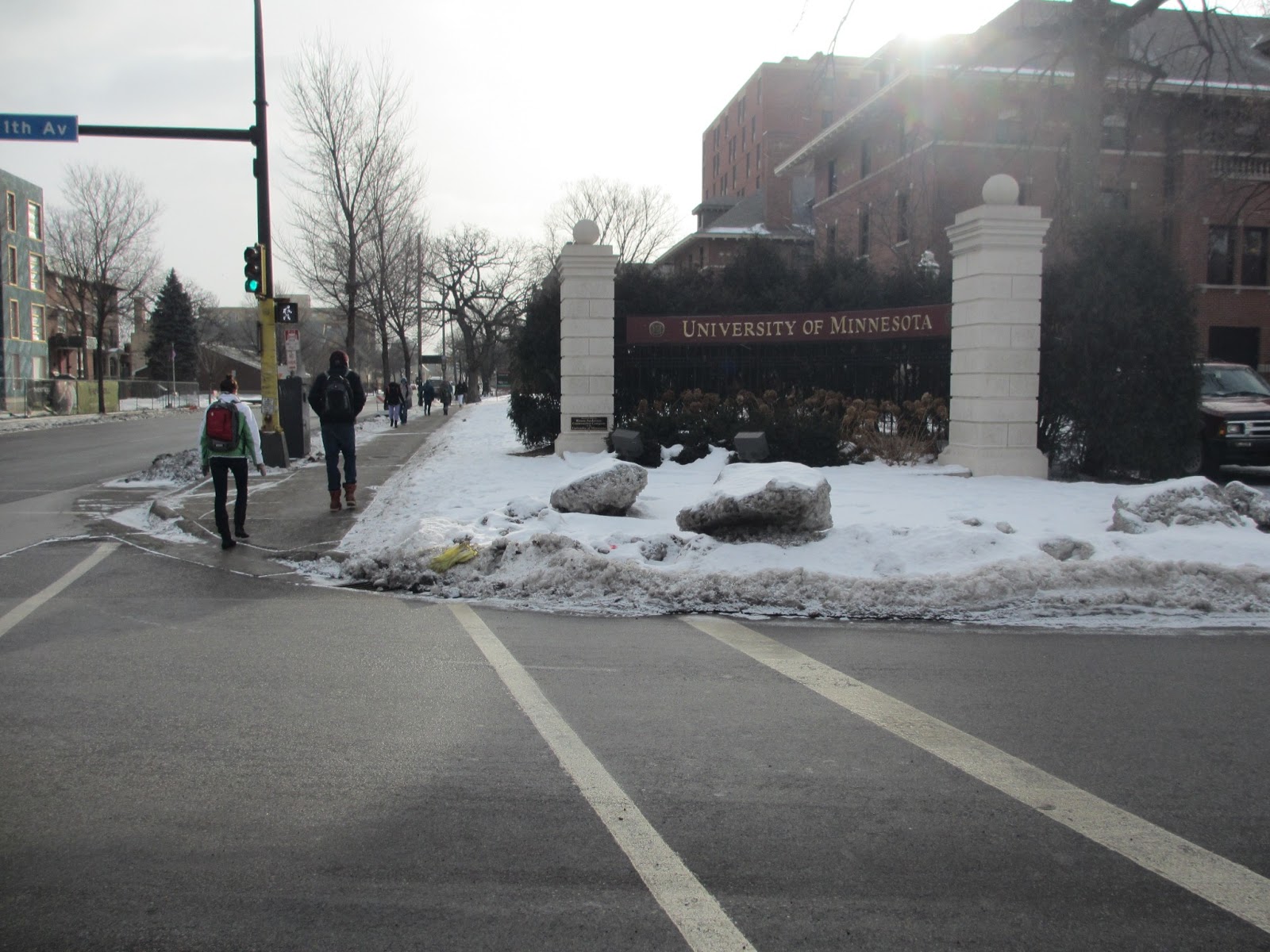
For this challenge, I decided to look at a street with no businesses on it, but still plenty of foot traffic. I chose the area where the traffic on University divides to westbound 4th Street. This stretch is home to most of the large athletic venues for the U, TCF Bank Stadium, Williams Arena, Mariucci Arena, and Ridder Arena. This was a busy day at these venues, with there being a home men’s basketball game and both a men’s and women’s hockey game occurring.
The first time I observed was around 11am. This was on a Saturday, so it was not too busy. Mostly car traffic with a few buses. A person or two passed, but very little foot traffic. This street is a bit intimidating, due to the high traffic volume (3 lanes) all going one way. However, at this location, a light at Oak Street and the arenas themselves act to bridge this gap. Also, the stadium was built with a large plaza for gathering before and after games.
The next time was after the men’s basketball game, 4:30pm. There was a lot of foot traffic, mostly leaving Williams Arena. I noticed that a majority of the people were crossing at Oak, due to the high number of parking lots around the stadium and Mariucci. There was very little movement along 4th Street, other than cars. There was also considerable movement between Williams and the Buffalo Wild Wings in Station 7. I wasn’t able to spend as much time observing during this time because I had my mellophone from pep band, and it was a but awkward holding it while observing.
The final time I observed was during the men’s hockey game (7:30pm). While there was evidence of large groups of people, there were very few on the street. The only pedestrians were the lone scalpers attempting to get whatever they could for their last ticket. Traffic flow was about average and there was more movement along 4th due to Mariucci’s location on the north side of the street.
What I learned from this exercise is that a street like 4th, which is mostly a traffic corridor, does not operate like a street in a business district. Rather than a consistent flow of foot traffic, the ebb and flow of pedestrians on 4th depends solely on events in the surrounding venues. When Williams’s doors opened after the game, there was a mass of maroon and gold flowing down and across the street. There was an air of energy because the Gophers had won. Ditto with during the hockey game. While there were not as many people on the street, the fact that there had been thousands only minutes ago as well as the energy inside Mariucci spilled onto the street and it felt strangely alive for how desolate it actually was.
For this challenge, I decided to look at a street with no businesses on it, but still plenty of foot traffic. I chose the area where the traffic on University divides to westbound 4th Street. This stretch is home to most of the large athletic venues for the U, TCF Bank Stadium, Williams Arena, Mariucci Arena, and Ridder Arena. This was a busy day at these venues, with there being a home men’s basketball game and both a men’s and women’s hockey game occurring.
The first time I observed was around 11am. This was on a Saturday, so it was not too busy. Mostly car traffic with a few buses. A person or two passed, but very little foot traffic. This street is a bit intimidating, due to the high traffic volume (3 lanes) all going one way. However, at this location, a light at Oak Street and the arenas themselves act to bridge this gap. Also, the stadium was built with a large plaza for gathering before and after games.
The next time was after the men’s basketball game, 4:30pm. There was a lot of foot traffic, mostly leaving Williams Arena. I noticed that a majority of the people were crossing at Oak, due to the high number of parking lots around the stadium and Mariucci. There was very little movement along 4th Street, other than cars. There was also considerable movement between Williams and the Buffalo Wild Wings in Station 7. I wasn’t able to spend as much time observing during this time because I had my mellophone from pep band, and it was a but awkward holding it while observing.
The final time I observed was during the men’s hockey game (7:30pm). While there was evidence of large groups of people, there were very few on the street. The only pedestrians were the lone scalpers attempting to get whatever they could for their last ticket. Traffic flow was about average and there was more movement along 4th due to Mariucci’s location on the north side of the street.
What I learned from this exercise is that a street like 4th, which is mostly a traffic corridor, does not operate like a street in a business district. Rather than a consistent flow of foot traffic, the ebb and flow of pedestrians on 4th depends solely on events in the surrounding venues. When Williams’s doors opened after the game, there was a mass of maroon and gold flowing down and across the street. There was an air of energy because the Gophers had won. Ditto with during the hockey game. While there were not as many people on the street, the fact that there had been thousands only minutes ago as well as the energy inside Mariucci spilled onto the street and it felt strangely alive for how desolate it actually was.
| 11:00am |
| 3:00pm |
| 7:30pm |
Weekly Wayfinding: Interact with Someone on the Street
Eye Candy
I’m not the kind of person who will walk up to strangers and say hi. So for this challenge I decided to experiment with eye contact. During one of my commutes to campus, whenever I was on a sidewalk, I tried to make eye contact with everyone I met. My results were quite interesting. Overall, I was much more likely to maintain eye contact with females (beyond the initial glance) than males. Also, as I got to campus and the number of people on the sidewalks increased, I made longer connections of eye contacts with people. I think this is because in a neighborhood setting with only 2 people on the sidewalk, it is more intimate, thus people are less likely to make eye contact with someone they don’t know. On campus with a very crowded sidewalk, it is possible to make eye contact with someone relatively anonymously. Thus, there is less at stake, less of an invasion of privacy. This was quite the interesting experiment.
Weekly Wayfinding: Different Route to School
The 6
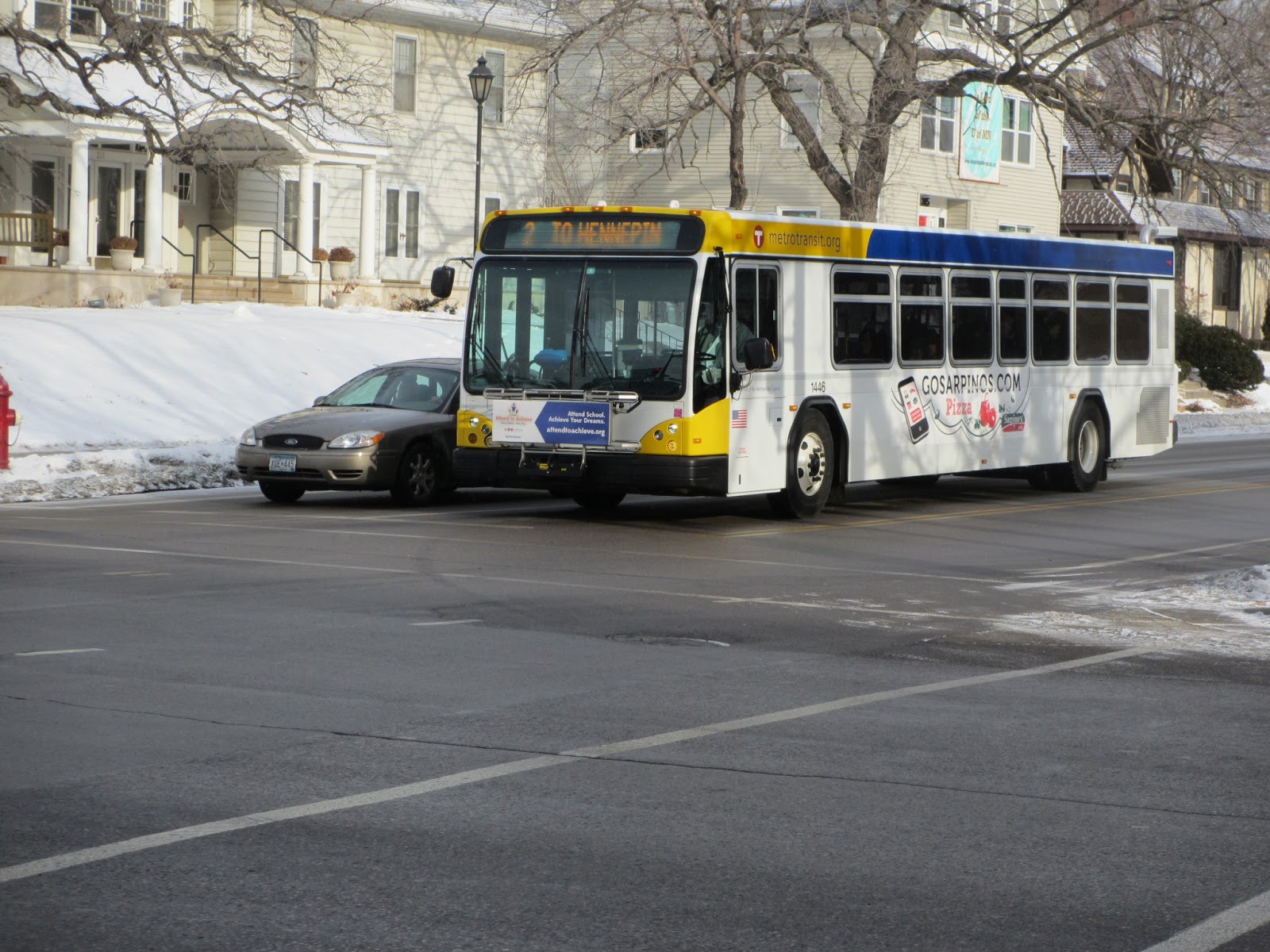
During the winter, I have one route and one route only to campus. That is walking a block and a half to the 2 stop at 8th and 5th. Then, I ride the 2 to the 15th and University stop. Then I get off, cross 15th, walk between Jones and Folwell Halls to Rapson Hall. (This is the route marked in white and orange) For this challenge, I took the only other bus through Marcy Holmes that goes to campus, the 6. It runs down University, so I had to walk from 7th and 4th to University and 4th. It took nearly 10 minutes, because I had to wait on the light at 4th Street and play frogger at University. The 6 stopped at every stoplight on University so the ride itself took 10 minutes as well. I finally got off the bus at University and 17th/Church. From there, I walked the block to Rapson Hall, entering the other atrium entrance. Total, this trip took 20 minutes, compared to the usual 10 minutes. The bus was also much less crowded and carried more adults than students, compared to the crowded with students 2. I also noticed I was more anxious and agitated when I got to campus after this alternate route, due to the busy streets I had to navigate to get to the stop as well as the ridiculous amount of time it took to drive 10 blocks. I think I will stick to my 10 minute commute on the 2. It is a much calmer start to my day.
Saturday, February 16, 2013
Weekly Wayfinding: Social Path
Paved Paths Can Be Social Too
Social paths are generally defined as being paths people take that are not paved or deliberately laid out as movement corridors. However, near Rapson Hall, there is a path, paved with pavers, that is absolutely a social path. It is located near the west entrance to the atrium. When there is no snow, it becomes clear that this path is more for aesthetic reasons that for actual circulation. To the left of the path, there is a similar path leading to another entrance to the atrium. Nobody uses this path, despite it being paved. What makes the social path so used is a mindset. Only group in particular uses this route into Rapson Hall, those of us who live there. Your first time entering Rapson, chances are you will not use this path. It is sloped, slightly uneven, and slippery during winter. However, when you are an architecture or landscape design student, chances are you will use this path when entering the building. It is the quickest way in, and we cannot afford to waste any of our valuable studio time. Also, it is somewhat of a status symbol. Trekking this path shows to others on the street that you belong, that you are a CDes student and proud of it.
This path as social is evident in the winter because this walkway is never plowed. But as the photo shows, it is not only trampled down, but completely clear due to the high number of arch and LA students dragging their feet into Rapson 24/7. The social use of this pathway take it from a landscape feature to a social path.
Social paths are generally defined as being paths people take that are not paved or deliberately laid out as movement corridors. However, near Rapson Hall, there is a path, paved with pavers, that is absolutely a social path. It is located near the west entrance to the atrium. When there is no snow, it becomes clear that this path is more for aesthetic reasons that for actual circulation. To the left of the path, there is a similar path leading to another entrance to the atrium. Nobody uses this path, despite it being paved. What makes the social path so used is a mindset. Only group in particular uses this route into Rapson Hall, those of us who live there. Your first time entering Rapson, chances are you will not use this path. It is sloped, slightly uneven, and slippery during winter. However, when you are an architecture or landscape design student, chances are you will use this path when entering the building. It is the quickest way in, and we cannot afford to waste any of our valuable studio time. Also, it is somewhat of a status symbol. Trekking this path shows to others on the street that you belong, that you are a CDes student and proud of it.
This path as social is evident in the winter because this walkway is never plowed. But as the photo shows, it is not only trampled down, but completely clear due to the high number of arch and LA students dragging their feet into Rapson 24/7. The social use of this pathway take it from a landscape feature to a social path.
Saturday, February 9, 2013
Weekly Wayfinding: Alternative Mode of Transportation
I Can't Feel My Fingers: 2/4/13
My typical mode of transportation to get to campus is the bus (route 2). So for this challenge, I decided to walk. There are many benefits to walking, ranging from personal health to less cars on the road. It also allows me to experience street, or lack thereof, firsthand. While I am used to walking around campus, I rarely walk to campus, as it involves crossing the canyon that is [Interstate] 35W. But today, I decided to take the challenge.
| I chose the absolute best day of the week to walk to campus. It was a balmy -22 degrees wind chill. |
| Luckily, my walk took me right by a Dunn Bros. Coffee break! |
| Not the most pedestrian friendly place to park your truck... |
| Would it not be for this challenge, I would be nice and warm on that bus. |
| I made it! Campus! |
| This was the first area design specifically for pedestrians. Everywhere else I walked was a car-centric designed corridor with a sidewalk alongside. |
| My favorite thing about walking is the view. Good morning, Minneapolis! I love how walk-able of a city you are! |
| Campus is much more pedestrian friendly. Wider sidewalks, less car traffic, and much more foot traffic. |
| Finally, home sweet home. By this point, I had lost all feeling in my fingers. |
Street Life Wayfinding Posts
Do I even need to say it? I'm bad at this game. Said it. So to help me continue posting despite my chaotic schedule, I am going to start posting a fun assignment I have for my Street Life seminar. We have weekly wayfinding challenges, things that involve us getting out on the street and interacting with it in some way, that we have to do weekly. We have to post it on a class tumblr for Carrie (our teacher) to evaluate. It's actually quite entertaining. I will start posting my weekly entries on here. But in case you want to read the rest of the class's, click here.
Thanks! And keep on keepin on!
Subscribe to:
Posts (Atom)